German Citizenship Test 2026: How to Pass the Einbürgerungstest
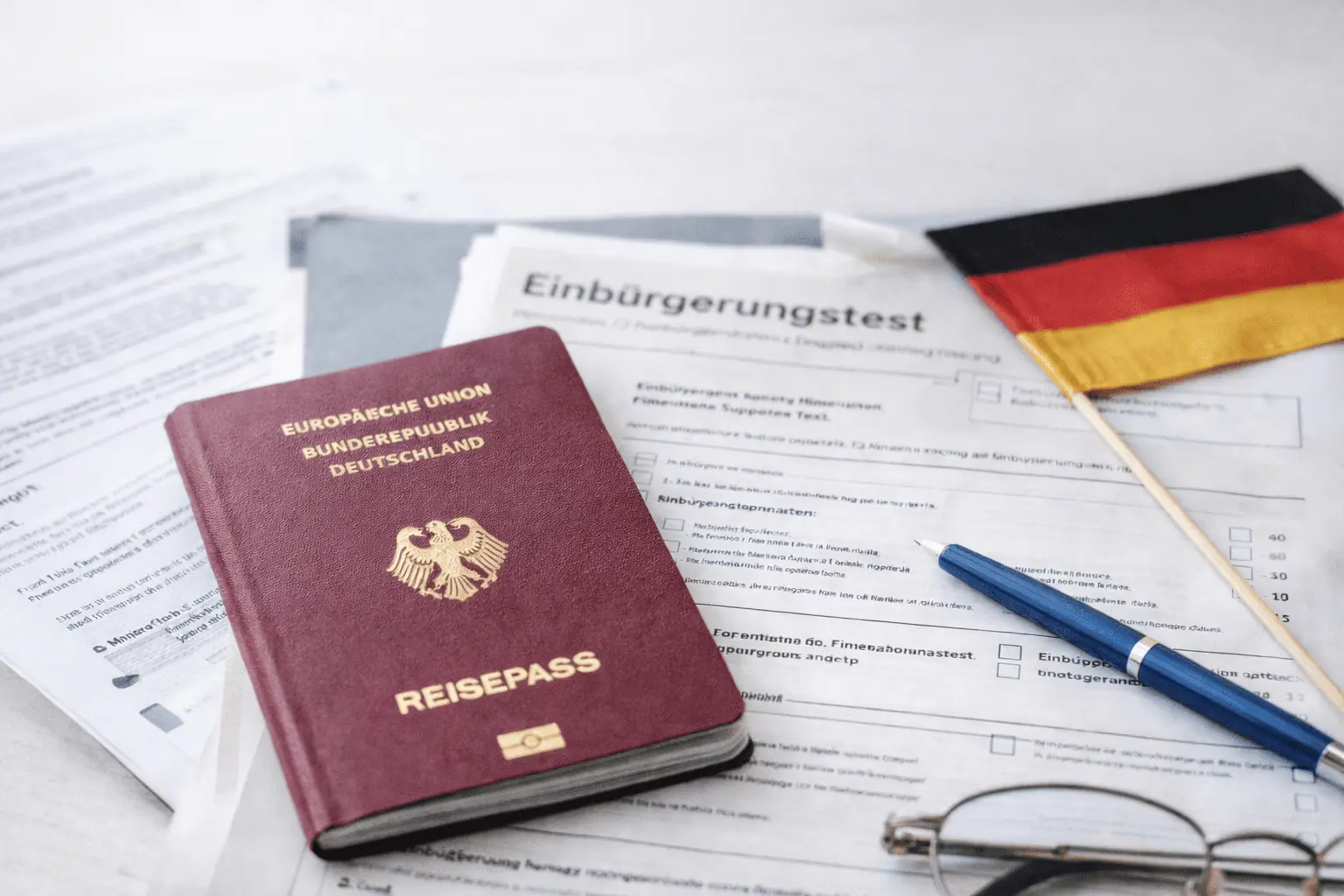
The German citizenship test makes many people feel stressed, especially if you are taking it for the first time. But the Einbürgerungstest is simpler than it seems. The format is standard, the questions are typical, and the rules are clear. The most important thing is not to try to learn “everything at once”, but to prepare properly: find where to take the test, how to register, and what to bring with you.
In this 2026 guide, we have collected all the basics you need before the exam: how the Einbürgerungstest works, how much it costs, what the registration process looks like, when the results arrive, and where beginners most often make mistakes.
What is the Einbürgerungstest and when is it required?
Einbürgerungstest is an official test that checks basic knowledge about life in Germany. The questions cover democracy, human rights, the political system, history, and the rules of living together. Most often, this test is required for those who are applying for German citizenship (Einbürgerung).
An important point: when people say “citizenship test”, they sometimes mean different things. In practice, people usually confuse:
- Einbürgerungstest (a test about life in the country, sometimes searched as the “Leben in Deutschland Test”)
- language proof (often B1 level is required, but it depends on your situation)
Test structure: 33 questions, 60 minutes, passing score
The Einbürgerungstest has a very clear format. If you have seen example questions at least once, there will be almost nothing unexpected during the actual exam.
Main parameters of the Einbürgerungstest
- 33 questions in the test booklet
- 60 minutes to complete it
- The test is passed if you answer at least 17 out of 33 questions correctly
- Multiple-choice format (1 correct answer out of 4)
Quick overview of the format
| Parameter | How it actually is | What it means |
|---|---|---|
| What it means | 33 | There are not many questions, the key is to get used to the wording |
| Time | 60 min | There is enough time if you do not get stuck on one question |
| Passing score | 17 correct answers | You do not need to know everything perfectly, you just need to reach the minimum score |
| Question type | 1 out of 4 options | There are no written answers, only multiple-choice selection |
| Where you take it | Prüfstellen (often VHS) | The location depends on the city, and registration is usually done separately |
Citizenship test
If you want to quickly check yourself before preparing, take our Einbürgerungstest practice test online on Lingolou
33 questions
StartHow much does the German citizenship test cost in 2026?
The Einbürgerungstest usually costs 25 euros per attempt.
Naturalization (obtaining citizenship) costs 255 euros per person. For minor children who are naturalized together with their parents, 51 euros must be paid. Minors who are naturalized without their parents must also pay 255 euros.
If you earn very little or several children are being naturalized, the fee may be reduced or payment in installments can be arranged.
This amount is stated in official sources: on the BAMF website (bamf.de), as well as on city portals (for example, ServicePortal Berlin) (Berlin Service Portal). The cost of the test is also regulated by official rules (Einbürgerungstestverordnung / EinbTestV). (Gesetze im Internet)
Can it be more expensive? Usually not. However, payment details (cash, card, or bank transfer) and rescheduling rules may differ depending on the Prüfstelle.
Each attempt is paid separately, so if you retake the test, you need to pay 25 € again.
Where to take it: VHS and other Prüfstellen
Most often, the Einbürgerungstest is held at a Volkshochschule (VHS). This is how many cities work, including Berlin: the VHS organizes the test as an official Prüfstelle on behalf of BAMF. (Berlin)
The BAMF website also states that your Einbürgerungsbehörde can help with questions about the test and with finding the nearest Prüfstelle. You can also find lists of Prüfstellen there in the section with downloadable materials. (bamf.de)
To make it easier to navigate, below is a table with the most common options for where to take the test and how to quickly find the right place in your city.
Where to find the Einbürgerungstest in your city
| Option | Where it is usually held | How to find it | When it is suitable |
|---|---|---|---|
| Volkshochschule (VHS) | In most cities | VHS website → Deutsch/Integration → Einbürgerungstest / Leben in Deutschland | If you want a clear registration process and an official test center |
| Another Prüfstelle (test center) | Depends on the city | Google: “Einbürgerungstest Anmeldung + city” | If the test in your city is not conducted by the VHS |
| Einbürgerungsbehörde | City or district office | City website or BAMF | If it is not clear where exactly to apply |
| BAMF (official information) | Online | BAMF page + downloadable materials | If you need to find lists of Prüfstellen or check the rules |
A small tip: the registration procedure may differ from city to city. In some places, registration is available online, while in others it is only possible in person at the VHS, so always check the conditions at your specific Prüfstelle.
How to register for the Einbürgerungstest: step by step
Most often, the difficulty is not the test itself, but the registration process. Not because the procedure is complicated, but because each city has its own details: different deadlines, opening hours, forms, and payment rules.
Below is a universal step-by-step plan. As an example, you can follow the clearly described procedure on the ServicePortal Berlin. (Berlin Service Portal)
Step 1. Find a Prüfstelle and an available date
In some cities, dates are available far in advance, while in others they appear gradually when a new group is formed.
Step 2. Complete the registration (often done on site)
In Berlin, for example, the form is filled out during a consultation at the VHS. You need a valid document that proves your identity. (Berlin Service Portal)
Step 3. Pay the fee
The standard cost of the Einbürgerungstest is 25 €. (Berlin Service Portal)
Step 4. Save your registration confirmation
After registering, it is best to save or take a photo of:
- the date and time
- the address
- the rules (what to bring, when to arrive, what to do if you are late)
Step 5. Check the registration deadlines
Many Prüfstellen require you to register in advance. In Berlin VHS centers, for example, it is often mentioned that you should register a few weeks before the test date. (Berlin)
Citizenship test
If you want to quickly check yourself before preparing, take our Einbürgerungstest practice test online on Lingolou
33 questions
StartWhat documents do you need for the exam?
On the day of the Einbürgerungstest, you must bring a valid photo ID. This is clearly stated by BAMF on the official test page. (bamf.de)
Usually, it is enough to bring:
- passport / ID / Aufenthaltstitel (any valid document that proves your identity)
- registration confirmation or invitation to the test (if it was issued or sent)
- a pen (sometimes it is provided on site, but it is safer to bring your own)
If you do not have a photo ID, you may not be allowed to take the test, so it is better to check everything at home in advance.
How the test goes on the day you take it
If you imagine an examiner who will “catch you out”, you can relax: the Einbürgerungstest is taken in a written format, with no oral part.
Usually, you arrive 10–15 minutes before the start, show your photo ID, and listen to a short briefing. Then you receive the test questions and an answer sheet. After that, it is simple: you read each question and choose the correct option (1 out of 4). When you finish, you hand in the answer sheet and you can leave.
A practical tip: do not get stuck on one question. If you are unsure, mark it and move on. Often the answer becomes clearer later, once you get used to the wording and “get into the rhythm”.
When the results arrive and what to do if the letter takes a long time
After the test, you usually want to get your result as quickly as possible. But the Einbürgerungstest is checked centrally, so the result does not arrive immediately.
Real timeframes
Information from Berlin’s VHS Pankow states that the result is sent by BAMF, and this usually takes 6–8 weeks. (Berlin)
There is also an important note: if the letter has not arrived after about 8 weeks, you should contact the relevant regional BAMF office, because the VHS does not handle sending out certificates. (Berlin)
What to do if the result takes longer than expected
- Check whether 6–8 weeks have already passed since the test date (sometimes delays happen due to workload).
- If the waiting time is clearly longer, follow the instructions from your Prüfstelle or your city portal. Usually, this means contacting BAMF or the regional office. (Berlin)
Preparation for the Einbürgerungstest: a 7–14 day plan
You do not need to stay up all night studying questions for the Einbürgerungstest. The best approach is simple: short practice sessions, but regularly. This is especially convenient if you work, have a family, or simply want to prepare without stress.
One-week plan (calm but effective)
Here is a preparation format that can realistically fit into a normal schedule:
- Complete 33 questions in practice mode without a timer (you can do this on our service Lingolou). Then mark 2–3 topics where you make the most mistakes, for example elections, rights, federalism.
- Take a practice test every day or at least every other day. Even 20–30 minutes a day is enough to get used to the wording and steadily improve your score. After each test, quickly review your mistakes and understand why the correct answer is the right one.
- A few days before the exam, do 1–2 full simulations in the real format. Answer 33 questions in 60 minutes, just like on the actual exam. This will help you feel the pace and go into the test more calmly.
The day before the test, it is better to do a light review, prepare your documents, and check your route, rather than trying to “cram” another 200 questions.
If you have 14 days, it will be even easier
If you have more time, you can spread your preparation out more comfortably:
- practice for 20–30 minutes every day
- do a short mini-simulation every 2–3 days
- gradually improve the topics that feel more difficult
Common mistakes (and how to avoid them)
1) Preparing in a chaotic way
People often just open the questions and go through them one by one without any structure. Because of this, the information quickly gets mixed up, and everything turns into “a mess” in your head.
What helps: practice in blocks (democracy, rights, history), and only then mix the questions in a random order.
2) Trusting forum advice more than official rules
Forums can sometimes be reassuring, but they often contain confusion and incorrect facts. It is more reliable to check information in official sources:
- rules, costs, and required documents: BAMF (bamf.de)
- registration and procedures in your city: city portals (for example, Berlin) (Berlin Service Portal)
3) Never taking the test in the “33 questions in 60 minutes” format
Knowing the answers and finishing within the time limit are two different things. Without a simulation, it is harder to feel the pace, and you may get confused during the real test.
What to do: take the full 33-question practice test with a timer at least 1–2 times, just like in the exam.
4) Forgetting your identity document
It is a small thing, but it can really ruin your day. To take the test, you need to bring a valid identity document, such as a passport, an ID card, or an Aufenthaltstitel.
Conclusion
In 2026, the Einbürgerungstest has a clear and easy-to-understand format: 33 questions, 60 minutes, and a passing minimum of 17 correct answers. If you find your Prüfstelle in advance, register for a date, prepare your documents, and practice the questions at least a few times, passing the test on your first attempt is absolutely realistic.
FAQ
How much does the Einbürgerungstest cost in 2026?
The official cost of the Einbürgerungstest in 2026 is 25 euros. Each attempt is paid separately, so if you retake the test, you need to pay the fee again.
How many questions are in the Einbürgerungstest and what is the passing score?
There are 33 questions in the test. You have 60 minutes to complete it. The test is considered passed if you answer at least 17 out of 33 questions correctly.
How many questions are there in the Einbürgerungstest question bank?
The official question catalog contains 310 questions. 300 questions are general for all of Germany, and 10 questions depend on your federal state.
Where can you take the Einbürgerungstest?
The test is held at official test centers (Prüfstellen). In many cities, the Einbürgerungstest is most often taken at the Volkshochschule.
How to register for the Einbürgerungstest in your city?
First, you need to find a test center in your city, then choose a date, complete the registration, and pay the fee. In some cities, registration is available online, while in others it can only be done in person.
What documents do you need for the Einbürgerungstest?
You need to bring a valid photo ID to the test. Most often, this is a passport, an ID card, or an Aufenthaltstitel. It is also recommended to have your registration confirmation if it was sent to you.
How does the Einbürgerungstest work on the day of the exam?
It is a written multiple-choice test. In each question, you need to choose one correct answer out of four options. There is no oral part.
When do the Einbürgerungstest results arrive?
The results are sent by BAMF by mail. In most cases, you need to wait примерно 6–8 weeks after the test date.
Can you retake the Einbürgerungstest if you did not pass?
Yes, you can take the test again. However, each retake must also be paid for separately.
What document will I receive after taking the Einbürgerungstest?
After the test is checked, BAMF sends an official letter or certificate with your result. This is the document you need to include in your citizenship application package.